
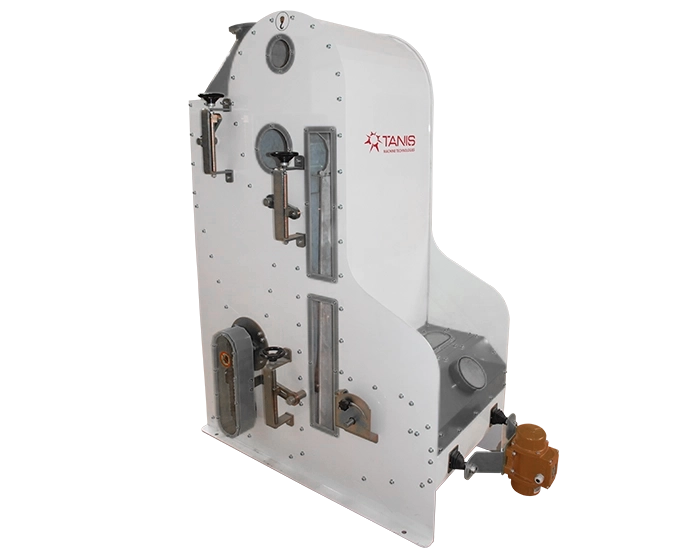


Vibro Classifier
Vibro Classifier: Precise Vibration-Based Grain Cleaning System
The Vibro Classifier manufactured by Tanış A.Ş. is a superior performance system that precisely cleans your grains using the cleaning power of vibration technology. This innovative technology, developed in our production facilities based in Gaziantep with our experience in wheat, corn, and barley processing equipment, increases the efficiency of your mill processes with high efficiency and easy maintenance features.

Vibro Classifier is a special machine designed to separate foreign materials in the grain cleaning process using vibration technology. Its basic function is to effectively remove straw, dust, husks, light stones, and other unwanted materials within grains, providing clean and homogeneous grain to the mill process.
Vibration technology significantly increases the effectiveness of the cleaning process. Controlled vibration movement provides precise separation by utilizing the differences between the physical properties of grain and foreign materials. This vibration creates density, size, and aerodynamic differences between grain and foreign materials, achieving effective separation.
Its position in the mill cleaning line is generally after coarse cleaning and before tempering stage. This strategic position increases the efficiency of subsequent process steps and minimizes wear of mill equipment. Vibro Classifier often works together with stone separators and screens to create a comprehensive cleaning system.
The effect of clean grain on flour quality is direct and evident. Grain effectively purified from foreign materials results in higher yield, better color, and lower ash content. Considering that Turkey is an important wheat and barley producer, quality cleaning process provides competitive advantage.
Vibration principle and effective cleaning mechanism form the heart of Vibro Classifier. Controlled vibration created through balanced eccentric weights provides superior separation by utilizing the mechanical behavior differences of grain and foreign materials. This vibration optimizes grain movement on the screening surface, offering maximum cleaning effectiveness.
The effectiveness of vibratory movement in separating different foreign materials is superior to traditional systems. Especially dust, husk pieces, and light foreign materials can be separated much more effectively in vibratory systems. Vibro Classifier stands out in the sector with over 95% foreign material removal performance.
Precisely adjustable vibration parameters provide optimum cleaning for different grain types and contamination levels. Parameters such as vibration frequency, amplitude, and inclination angle can be easily adjusted according to grain type and foreign material characteristics, thus offering a customized cleaning process for each application.
The synergistic effect of air flow and vibration combination maximizes Vibro Classifier’s separation effectiveness. While vibratory movement loosens and aerates the grain, precisely controlled air flow lifts light foreign materials and removes them from a separate outlet. This dual effect provides much more effective results than using air flow or vibration alone.
Low energy consumption and efficient operation are among the economic advantages of Vibro Classifier. Optimized vibration mechanism and efficient fan system minimize energy consumption per ton. This efficiency directly contributes to reducing operating costs.
Vibration motor and motion transmission system are precision engineering products. Specially designed eccentric weights and balanced rotor structure provide maximum and controlled vibration with minimum energy. This system offers stable performance for long periods without requiring maintenance.
Vibration frequency and amplitude adjustments optimize cleaning performance. Typical operating frequency is in the range of 850-950 rpm, while amplitude can be adjusted between 3-6 mm. These parameters are precisely adjusted according to grain type and contamination level to ensure optimum cleaning.
Shock intensity control affects both cleaning effectiveness and equipment life. Shock intensity can be precisely controlled with electronic frequency control systems or mechanical adjustment mechanisms. This control enables providing ideal cleaning conditions for different grain types.
Balanced operation and structural stability are the keys to Vibro Classifier’s long-lasting performance. Specially designed spring systems and vibration isolators ensure controlled transmission of vibration to the cleaning unit while minimizing transfer to machine chassis and building structure.


Technical Specifications and Performance Values
Tanış Vibro Classifier is offered in various technical specifications:
- Dimensions: 1200x800x1600mm – 2000x1200x2200mm (according to model size)
- Capacity: 5-25 tons/hour (depending on model and grain type)
- Weight: 500-1400 kg (according to model size)
- Screen surface: 1-3 m² (varies according to model)
Vibration motor characteristics and power values vary according to model size. Small models use 1.1-1.5 kW, medium models use 2.2-3.0 kW, and large models use 4.0-5.5 kW power. Specially balanced motors provide optimum vibration with minimum energy.
Air flow system and fan capacity play a critical role in cleaning performance. Fan capacity varies between 3,000-8,000 m³/hour according to model. Air flow can be easily adjusted through precise dampers, thus ensuring maximum cleaning effectiveness in different grain types.
Processing capacity depends on model size and grain type. VT-10 model has processing capacity up to 10 tons per hour, VT-15 model up to 15 tons, VT-20 model up to 20 tons, and VT-25 model up to 25 tons per hour. This wide capacity range offers solutions for every scale from small mills to large industrial facilities.
Electricity consumption and efficiency ratios are important for operating economy. Vibro Classifier consumes an average of 0.2-0.3 kWh energy per ton. This low consumption is achieved through efficient vibration system and optimized fan design.
Model Options and Capacity Alternatives
Model variations are available for different production scales:
- TMVT-60: For small businesses with 4 tons/hour capacity
- TMVT-80: For medium-scale mills with 4-8 tons/hour capacity
- TMVT-100: For large facilities with 8-10 tons/hour capacity
- TMVT-120: For industrial-scale facilities with 12-18 tons/hour capacity
Capacity ranges and selection criteria are determined according to mill size, grain type, and contamination level. Tanış engineering team provides technical support in selecting the most suitable model for your needs.
Optional configurations can be offered for special requirements. Double-layer screen systems, integrated aspiration units, special dust collection solutions, or automation options can be customized according to customer needs.
Cleaning Effectiveness and Separation Capability
Performance in removing different foreign material types is the fundamental quality indicator of Vibro Classifier. With the combined effect of vibration and air flow, a wide variety of foreign materials are effectively separated:
- Dust and very light particles: 98-99% removal effectiveness
- Husk and straw pieces: 95-97% removal effectiveness
- Light stones and sand: 90-95% removal effectiveness
- Weak and damaged kernels: 85-90% removal effectiveness
Effectiveness in separating light foreign materials (straw, husks, dust) is maximized through the combination of vibratory system and optimized air flow. This effectiveness provides great advantage especially in cleaning light contaminants that directly affect flour quality.
Cleaning efficiency according to grain size and quality can be optimized thanks to adjustable parameters. Lower vibration frequency and higher air flow are recommended for large-grain cereals, while higher frequency and more precise air control are recommended for small-grain cereals.
Minimized product loss is of critical importance for economic efficiency. Vibro Classifier keeps waste rate below 0.5% thanks to its precisely adjustable parameters without compromising cleaning effectiveness. This low loss rate provides significant economic savings on an annual basis.
Cleaning Performance and Quality Parameters
Cleaning effectiveness measurement results confirm Vibro Classifier’s superior performance. In tests conducted under laboratory conditions, foreign materials at 4-6% rate in dirty wheat were reduced to 0.2-0.4% level after processing.
Field tests and laboratory analyses have shown similar results under real working conditions. Consistent cleaning performance has been achieved even in grains from different geographical regions with different contamination profiles.
Cleaning efficiency comparison for different grain types demonstrates Vibro Classifier’s versatility. 96% cleaning effectiveness for wheat, 94% for corn, and 95% for barley were measured. This consistent performance offers an ideal solution for mills working with various product ranges.
Installation and System Integration
Easy integration into existing cleaning lines is possible thanks to Vibro Classifier’s modular design. Standard inlet and outlet connections can be adapted to existing systems with minimum modification. This flexibility provides great advantage for both new installations and modernization projects.
Compact design and minimum space requirement ensure efficient use of facility space. Even the largest model occupies less than 3 m² floor space, which means saving valuable facility space. Vertical design concept provides layout flexibility.
Connection with dust collection systems is essential for environmentally friendly operation. Standardized aspiration connection points provide easy integration into existing dust collection systems. This integration protects indoor air quality and guarantees compliance with environmental regulations.
Assembly ease and installation process are managed by professional Tanış technical team. A typical installation can be completed within 1-2 days and is carried out with minimum production interruption. Detailed installation planning ensures smooth transition.
Usage and Operation Ease
User-friendly control system enables the operator to manage the machine effectively. Touchscreen control panel or analog indicators enable monitoring and adjusting all critical parameters. Intuitive design enables effective use with minimum training.
Adjustable parameters and calibration points provide optimization for different grain types and cleaning needs. Basic adjustable parameters:
- Vibration frequency and amplitude
- Air flow speed and pressure
- Screen inclination angle
- Feeding speed
Operating recommendations for optimum performance are provided by Tanış technical team. Recommended setting values for each grain type are detailed in the user manual. These recommendations maximize cleaning effectiveness while optimizing energy consumption.
Daily usage and control procedures are simple. Routine controls consist of visual inspection and simple cleaning operations. Automatic monitoring systems detect potential problems at early stages, minimizing operator intervention.
Maintenance and Service Advantages
Easily accessible parts and service points shorten maintenance time. Quick-opening covers and removable panels provide easy access to critical components. These design features simplify routine maintenance and cleaning operations.
Reduced maintenance requirements reduce operating costs. High-quality components and wear-resistant materials minimize maintenance needs. Vibration-resistant connecting elements and self-lubricating bearings extend maintenance intervals.
Planned maintenance schedule and control points extend equipment life and reduce failure risk. Recommended maintenance program:
- Weekly: Visual control and screen surface cleaning
- Monthly: Vibration motor and fan control
- 3-Monthly: Bearing control and lubrication
- 6-Monthly: Comprehensive control and replacement of worn parts
Long-lasting components and spare parts support ensure uninterrupted operation. Tanış A.Ş. offers spare parts guarantee and fast service support for all models. Keeping critical parts in stock minimizes downtime.
Energy Efficiency and Sustainability
Optimum energy use and saving features reduce operating costs. Efficient vibration mechanism and aerodynamic fan design minimize energy consumption per ton. This efficiency provides significant savings on an annual basis.
Efficient motor technology optimizes energy consumption. IE3 efficiency class motors and frequency converters provide maximum performance with minimum energy. These technologies both reduce electricity consumption and extend motor life.
Environmental impact and dust emission control contribute to sustainable production processes. Closed system design and effective dust collection mechanisms minimize environmental pollution. These features guarantee compliance with environmental regulations while protecting worker health.
Effective use of resources and sustainable operation are part of Tanış’s corporate values. Long-lasting design, energy efficiency, and reduced maintenance needs optimize resource use and offer a sustainable business model.
Economic Advantages and Investment Value
Positive effect on operating costs stems from low energy consumption and reduced maintenance needs. Operating cost per ton is 15-20% lower compared to traditional systems. This saving directly contributes to the operating budget.
Economic contribution of cleaning quality to final product is evident. Cleaner grain increases flour yield, reduces equipment wear, and improves final product quality. These improvements directly reflect as market value and competitive advantage.
Low maintenance costs and long service life reduce total cost of ownership. High-quality components and durable structure typically provide 15-20 years of service life. This long life significantly reduces equipment renewal costs.
Investment payback period calculation generally shows a 2-3 year period. Increased cleaning effectiveness, reduced operating costs, and improved product quality cover investment cost in a short time.
Industrial Applications and Usage Areas
Large-scale flour factories and integrated facilities are the main usage areas of Vibro Classifier. High-capacity models meet the cleaning needs of large facilities while providing consistent and reliable performance.
Suitable models are also available for medium and small-scale mills. More compact and economical versions enable small businesses to benefit from high-quality cleaning technology.
Usage diversity for different grain types demonstrates Vibro Classifier’s versatility. Besides basic grains like wheat, corn, and barley, optimized cleaning can be provided for rye, oats, and other grains.
Seed processing and animal feed production facilities are other common usage areas. The cleaning process, which is critical for seed purity and quality, can be optimized with Vibro Classifier. In animal feed production, higher nutritional value products can be obtained by improving raw material quality.
R&D and Innovation Studies
Tanış A.Ş.’s R&D studies in vibro classifier technology focus on continuous development. Innovations in vibration technology, material science, and flow dynamics continuously improve product performance.
Improvements made in line with customer needs increase the practical value of the product. Field experiences and user feedback are valuable inputs to the R&D process. Each new model is developed with knowledge gained from previous experiences.
Innovations and developments in vibration technology increase cleaning effectiveness. Advanced vibration control, optimized air flow, and smart sensor technologies will be fundamental features of next-generation Vibro Classifier systems.
Studies on next-generation classifier systems aim for smarter, more efficient, and more environmentally friendly solutions. IoT integration, remote monitoring, and automatic optimization are the main elements of future classifier technologies in Tanış’s vision.
Frequently Asked Questions
What is Vibro Classifier’s energy consumption and how much savings can it provide?
Depending on model size, total motor power is between 1.5-5.5 kW. 15-20% energy savings per ton can be achieved compared to traditional systems. This creates significant cost advantage on an annual basis.
Can the same machine be used for different grain types?
Yes, Vibro Classifier can be used for different grain types. Parameters such as vibration frequency, air flow speed, and screen configuration can be optimized for each grain type. Only simple adjustments are needed to switch between different grains like wheat, corn, and barley.
What are the maintenance frequency and requirements?
Under normal operating conditions, weekly visual control and monthly simple maintenance are sufficient. 6-month periods are recommended for comprehensive maintenance. Thanks to high-quality components and durable design, maintenance requirements are minimal.
How difficult and costly is integration into existing cleaning line?
Vibro Classifier’s modular design provides easy integration into existing lines. Thanks to standard connection points and flexible configuration options, integration with minimum modification is possible. A typical integration project can be completed within 1-3 days and requires additional investment of about 10-15% of machine cost.
How much grain loss occurs during cleaning process?
In a properly adjusted Vibro Classifier, grain loss is below 0.5%. Precisely adjustable parameters minimize waste rate without compromising cleaning effectiveness. This low loss rate significantly increases economic efficiency.
For more information and Vibro Classifier solutions suitable for your business, contact Tanış A.Ş. today. Our expert team is ready to offer solutions specific to your process needs.