

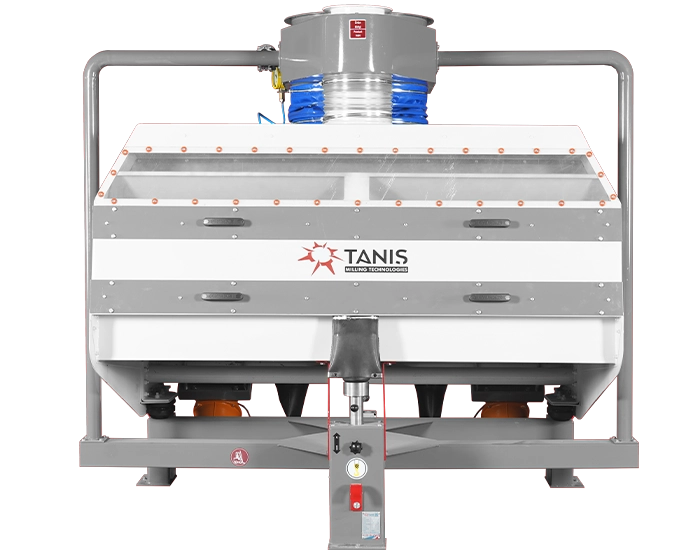
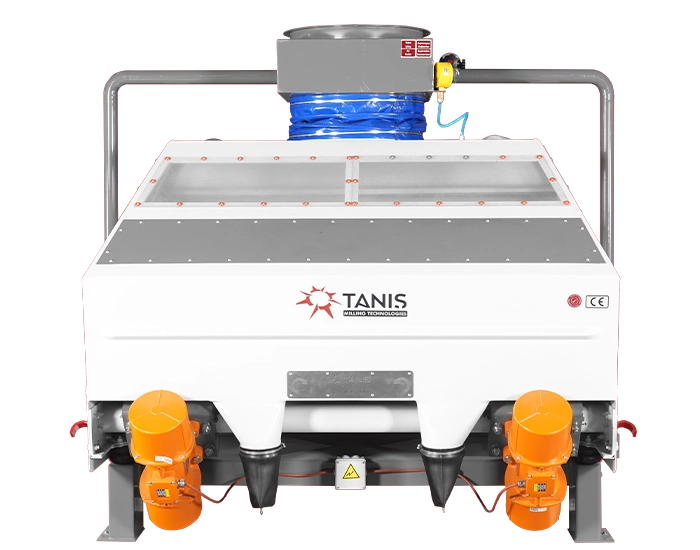

Multi-Layer Destoner
Multi-Layer Destoner: High-Efficiency Multi-Stage Stone Separation
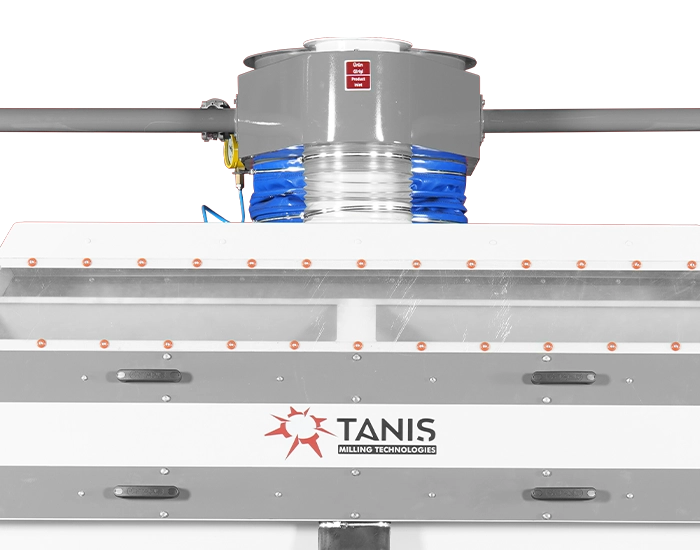
The Multi-Layer Destoner manufactured by Tanış A.Ş. is an advanced technology cleaning solution that effectively removes stones and heavy foreign materials from your grains through a multi-stage system. This multi-stage system, developed in our production facilities based in Gaziantep with our experience in wheat, corn, and barley processing equipment, protects your mill machine safety while preserving your flour quality.

Multi-Layer Destoner is a special cleaning equipment that removes stones and heavy foreign materials within grains in multiple stages. Its basic function is to completely remove hard foreign materials that could damage mill equipment from the grain flow. This way, your valuable mill equipment is protected while your product quality is also secured.
Its strategic position in the mill cleaning line is generally after coarse cleaning and before grinding stage. The destoner positioned at this critical point takes on the task of protecting especially roller mills, crushing cylinders, and other sensitive mill equipment. As the last line of defense in the cleaning process, its ability to catch even the smallest stones that might be overlooked is vitally important.
The damage that stones and heavy foreign materials cause to mill equipment can be serious. Especially roller mills and other sensitive parts get scratched, worn, and can even break when they come into contact with hard foreign materials. Such damages not only create expensive repair costs but also lead to production downtime and efficiency losses. Even a single stone that is not properly removed can cause thousands of dollars in damage.
Multi-stage design performs stone separation in multiple stages, providing much higher efficiency compared to single-stage systems. Each stage targets foreign materials of different sizes, offering maximum cleaning effectiveness. This multi-layer approach gives foreign materials that are not caught in a single pass a second, third, and even fourth chance to be caught.
The effect of layered system design on stone separation efficiency is evident. Each layer is optimized to catch stones of different sizes and weights. Those not caught in the first layer are caught in subsequent layers, thus achieving cleaning effectiveness close to 100%. Test results show that layered systems are 15-25% more effective than single-stage systems.
The advantages of staged separation principle show themselves in cleaning precision. Each layer targets foreign materials in a specific size range. Upper layers remove larger stones while lower layers remove smaller stones. This staged approach ensures effective catching of stones of different sizes that might be overlooked in a single stage.
The ability to catch foreign materials of different sizes is one of the strongest features of the layered system. Stones and foreign materials in a wide range from 0.5 mm to 10 mm can be effectively separated thanks to this multi-layer system. This wide range provides superior performance in catching all types of foreign materials.
Advantages over single-stage systems are:
- Higher cleaning efficiency (15-25% more effective)
- Stone separation capability in wider size range
- Lower grain loss rate
- Less downtime and maintenance need
The balance between compact design and high efficiency is another important advantage of Tanış Multi-Layer Destoner. Despite its multi-layer approach, it occupies minimum floor space thanks to its vertical structure. This compact design offers the opportunity to benefit from multi-stage stone separation technology even in facilities with space constraints.
Number of layers and staged cleaning phases form the foundation of system performance. Tanış Multi-Layer Destoner can contain 3-4 layers depending on the model. Each layer subjects the grain passing from the previous layer to more precise screening. This staged approach combines multiple cleaning phases in a single system, providing superior efficiency.
The function and working mechanism of each layer is as follows:
- First layer: Removes the largest stones and foreign materials, provides quick pre-cleaning
- Second layer: Targets medium-sized stones, offers slower flow and precise separation
- Third layer: Catches small stones and heavy particles, performs fine cleaning
- Fourth layer (optional): Provides ultra-precise final cleaning that removes even the smallest stones
The physics of separating stones and heavy foreign materials is based on specific weight difference. Stones and other heavy foreign materials move differently in specially designed channels because they are denser than grain kernels. This physical difference is the foundation of the separation process.
Gravity and motion-based separation technology uses controlled vibration and inclined surfaces. As the grain and stone mixture advances on vibrating inclined surfaces, heavy particles (stones) sink to the bottom and are directed to special channels. Lighter grain kernels remain on the surface and advance to the next stage.
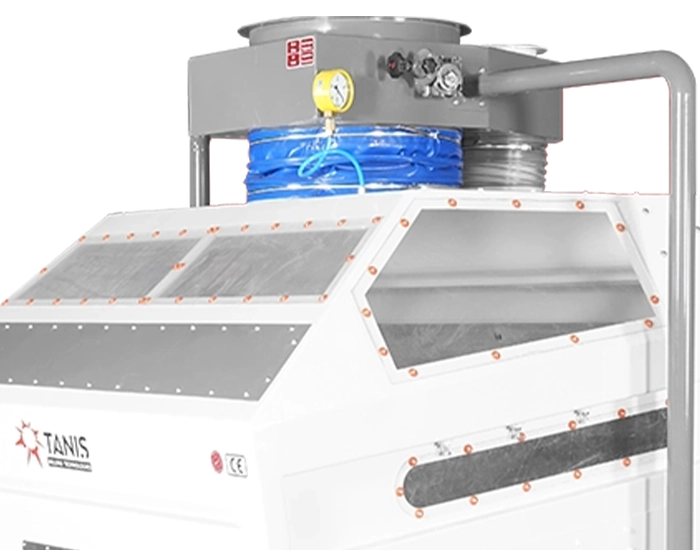
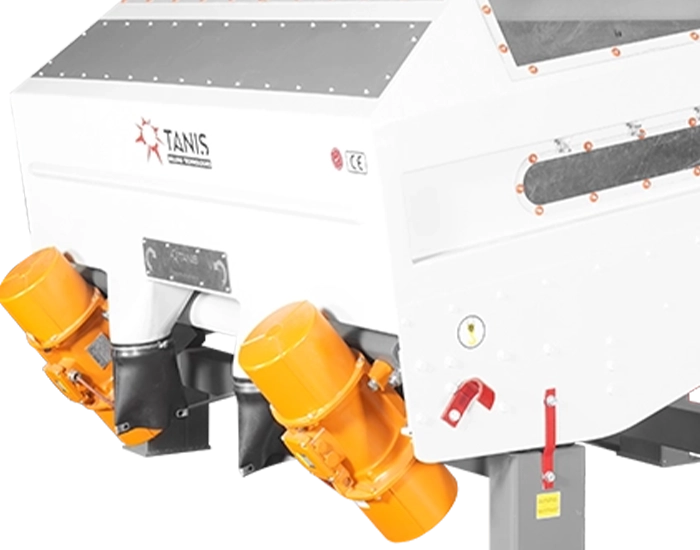
Technical Specifications and Performance Parameters
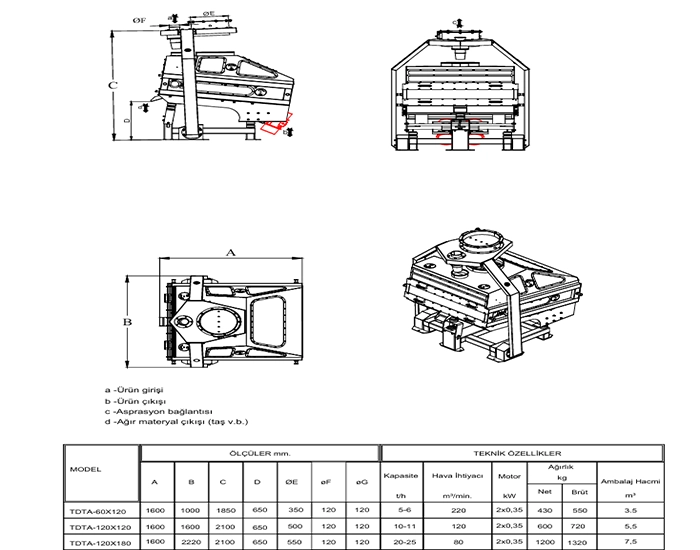
Tanış Multi-Layer Destoner has various technical specifications:
- Dimensions: 1200x1000x2000mm – 2000x1500x2800mm (according to model size)
- Capacity: 4-20 tons/hour (depending on model and grain type)
- Number of layers: 3-4 (according to model size)
- Weight: 700-1800 kg (according to model size)
Motor power and energy consumption values are optimized thanks to energy efficiency-focused design. Motor power between 1.5 kW and 4.0 kW is used depending on the model. This means low energy consumption of approximately 0.1-0.15 kWh per ton.
Processing capacity varies according to model size and grain type. The smallest model has processing capacity of 5 tons per hour while the largest model has capacity up to 40 tons per hour. This wide capacity range makes it possible to offer a suitable solution for mills of every scale.
Vibration mechanism and motion control systems are of critical importance for precise separation. Specially designed eccentric weights provide controlled and balanced vibration while frequency control systems allow precise adjustment of vibration intensity.
Adjustable parameters and precise calibration capabilities provide optimization for different grain types and contamination levels. Parameters such as vibration intensity, feeding speed, and inclination angle can be customized for each application.
Multi-Layer Destoner: Model Variations and Capacity Options
Model alternatives with different number of layers are:
- KTA-3: 3-layer standard model, ideal for most applications
- KTA-4: 4-layer high precision model, recommended for premium flour production
- KTA-3H: 3-layer high capacity model, designed for large facilities
- KTA-4H: 4-layer high capacity and precision combination
Capacity ranges and selection criteria according to business size are:
- TDTA-60/120: 4-6 tons/hour, for small-scale mills
- TDTA-120/120: 10-16 tons/hour, for medium-scale operations
- TDTA-120/180: 16-20 tons/hour, for large facilities
- KTA-40: 30-40 tons/hour, for industrial-scale operations
Configuration options are available for special requirements. Options such as reinforced upper layers for large stone separation capability, additional filters for ultra-precise separation, or special cleaning apparatus can be offered.
Stone Separation Performance and Effectiveness Evaluation
Effectiveness in catching stones of different sizes is the most important performance indicator of Multi-Layer Destoner. Test results show the following catching effectiveness:
- Stones over 5 mm: 99.9% catching rate
- 3-5 mm stones: 99.5% catching rate
- 1-3 mm stones: 98.5% catching rate
- 0.5-1 mm stones: 95-97% catching rate
The balance between minimum grain loss and maximum stone separation is of critical importance for economic efficiency. Tanış Multi-Layer Destoner keeps grain loss at very low levels of 0.2-0.3% without compromising stone separation effectiveness, thanks to its adjustable parameters.
Separation precision and calibration advantages provide optimization for different applications. The ability to adjust each layer separately offers precise calibration capability for different grain types and stone characteristics.
Performance test results and efficiency values have been confirmed in laboratory and field tests. Tests conducted under real working conditions prove that Multi-Layer Destoner is 15-25% more effective than single-stage systems.
Separation Precision and Quality Parameters
Minimum stone size catching capacity is an important parameter showing the system’s precision. While stones with 0.5 mm diameter can be caught in standard configuration, precision down to 0.3 mm can be achieved for special applications.
Performance comparisons in different grain types show system flexibility. Stone separation effectiveness of 98.5%+ for wheat, 99%+ for corn, and 98%+ for barley can be achieved. This consistent performance provides reliable results in various grain types.
The relationship between grain flow rate and separation effectiveness is important in determining the optimal working point. Working between 70-90% of nominal capacity provides the best cleaning/efficiency balance. Working outside this range can reduce either cleaning effectiveness or capacity efficiency.
Real performance data obtained from the field confirms the practical value of Multi-Layer Destoner. Tests conducted with grains from different geographical regions and contamination profiles have shown consistent and reliable performance.
Machine Protection and Contribution to Mill Safety
Its role in protecting roller mills and other sensitive equipment is the fundamental value proposition of Multi-Layer Destoner. Roller mills, crushing cylinders, and other sensitive parts can suffer major damage when they come into contact with hard foreign materials like stones. An effective destoner protects these valuable equipment pieces, both reducing repair costs and extending equipment life.
Its effect on reducing operational downtime is critical for production efficiency. Stone-related failures usually cause long-term downtime. Effective stone separation makes an important contribution to production continuity by minimizing these downtimes.
Prevention of unexpected breakdown and repair costs directly affects operational economics. A single stone-related roller mill damage can create thousands of dollars in repair costs and production loss. Multi-Layer Destoner provides significant cost savings by almost completely eliminating these risks.
Long-term maintenance cost savings accelerate investment return. Prevention of stone damage reduces maintenance needs of mill equipment and extends their life. This long-term saving ensures rapid amortization of the destoner investment.
Effect on Flour Quality and Production Advantages
Prevention of negative effects of stone contamination on flour quality is vitally important for product quality. Stones can mix into flour during grinding and create a serious health risk for consumers. Effective stone separation eliminates this risk, guaranteeing safe and quality flour production.
Ensuring compliance with food safety standards is a fundamental requirement of today’s food industry. Food safety systems like HACCP and ISO 22000 require an effective stone control mechanism. Multi-Layer Destoner meets these requirements, facilitating certification processes.
Protection and stability of final product quality is essential for brand reliability. Flour without stone contamination both shows better baking properties and protects consumer health. This quality consistency provides long-term customer satisfaction and brand loyalty.
Customer satisfaction and quality assurance create competitive advantage. Safe flour production without stones is an important differentiation point in the market. Use of Multi-Layer Destoner provides this assurance, increasing customer trust and expanding market share.
Installation and System Integration
Easy integration into existing cleaning lines is possible thanks to the modular design of Multi-Layer Destoner. Standard inlet and outlet connections can be adapted to existing systems with minimum modification. This flexibility provides an ideal solution for both new installations and modernization projects.
Compact design and space optimization ensure efficient use of facility space. Thanks to its vertical structure, it occupies minimum floor space. This feature provides great advantage especially in facilities with space constraints.
Installation process and requirements are managed by professional Tanış technical team. A typical installation can be completed within 1-2 days and requires minimum production interruption. Basic requirements are solid foundation, appropriate electrical connection, and standard inlet-outlet connections.
Commissioning and calibration operations are of critical importance for optimum performance. Tanış experts calibrate the system according to the grain type to be transported and expected foreign material characteristics. These precise adjustments ensure maximum cleaning effectiveness and minimum grain loss.
Usage and Operating Features
Operator-friendly control system and interface provide easy use. Simple and understandable control panel offers the capability to manage all parameter settings from a single point. Digital indicators enable instant monitoring of system status.
Easily adjustable parameters and operating modes provide rapid adaptation to different grain types. Basic parameters such as vibration intensity, feeding speed, and channel inclination can be easily adjusted by the operator. This flexibility provides rapid adaptation to changing operating conditions.
Daily control and operating procedures are simple. Routine controls consist of visual inspection and basic cleaning operations. The system is designed to operate largely automatically, minimizing operator intervention.
Performance monitoring and optimization recommendations are provided for maximum efficiency. Stone separation effectiveness, grain loss, and system performance are regularly monitored, allowing fine adjustments when necessary. This proactive approach ensures continuous optimum performance.
Maintenance and Service Ease
Low maintenance requirements and long service intervals reduce operating costs. High-quality components and wear-resistant materials minimize maintenance needs. Standard maintenance intervals are 6-12 months, which increases operational efficiency.
Easily accessible parts and service points shorten maintenance time. Quick-opening covers and modular design enable maintenance personnel to easily access critical components. This feature reduces maintenance time and therefore downtime.
Planned maintenance schedule and control points are essential for preventive maintenance strategy. Tanış provides a detailed maintenance guide and schedule for each model. This planned approach minimizes failure risk and extends equipment life.
Spare parts and service support are guaranteed by Tanış A.Ş. All common spare parts are kept in stock and fast shipping is provided. Additionally, professional service team is ready for quick intervention when needed.
For more information and Multi-Layer Destoner solutions suitable for your business, contact Tanış A.Ş. today. Our expert team is ready to offer solutions specific to your process needs.